As professionals in the solar industry, how to ground mounted solar panels cost? we all know that the cost of ground-mounted solar projects is never a fixed figure.
However, we can use a standard framework to calculate it clearly. This article cuts through the jargon and takes you step-by-step through every component of the cost of ground-mounted solar mounting systems, giving you a solid understanding from quotation to installation.
1. How Are Costs Calculated? Don’t Just Look at the Price Per Watt
Many buyers start by asking, “How much per watt?” While this figure can serve as a preliminary screening tool, the actual project budget goes far beyond that. The professional formula is: Total Cost = Equipment Costs + Civil Construction Costs + Electrical Connection Costs + Design and Management Fees + Contingency Costs.
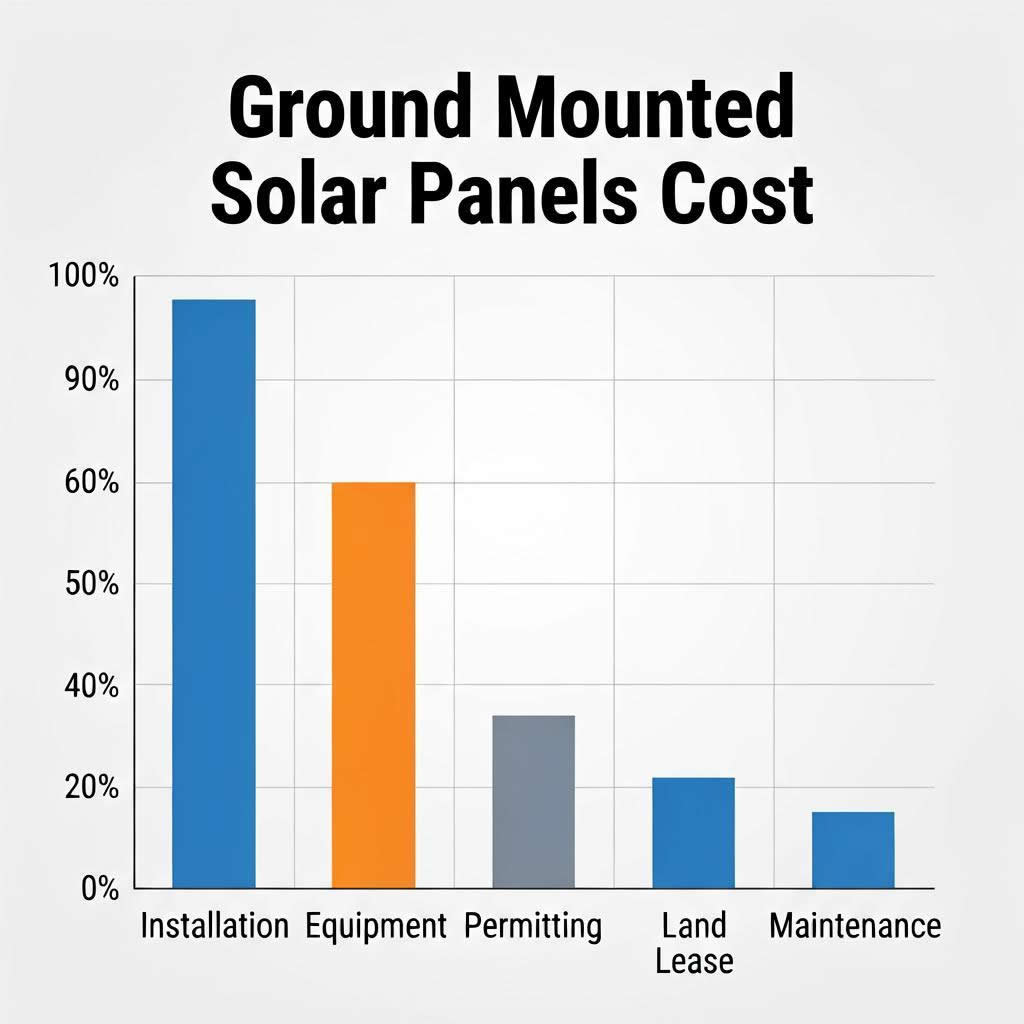
Step 1: First, determine your DC-side installed capacity (kWp). Multiply this figure by the market price of the modules and inverters to get a baseline estimate. Second, include all auxiliary materials such as mounting structures, screw piles or concrete foundations, DC cables, and cable trays. Third—and this is the step most often overlooked—account for site preparation, fencing, access roads, and drainage ditches; these preliminary works typically account for 8%–12% of the total investment. Don’t forget that the switchgear and metering equipment at the grid connection point are also fixed expenses. Finally, set aside at least a 5% contingency fund to cover on-site contingencies such as underground rocks or delays caused by the rainy season. Only by calculating in this way can you determine the true ground mounted solar panels costs.
2. What Exactly Is Included in the Quote?
A complete supplier quote must clearly list four major categories:
First, hardware equipment: PV modules, inverters, combiner boxes, mounting structures (fixed-tilt or trackers), DC cables, and grounding materials. Second, civil engineering: site clearance, surveying and staking out, pile foundation drilling or pouring, mounting structure installation, and module installation. Third, electrical engineering: cable laying, cable tray installation, wiring and commissioning, lightning protection and grounding, and fire protection facilities. Fourth, indirect costs: project design drawings, structural calculations, construction insurance, equipment transportation and hoisting, and on-site security. If the supplier provides only a total price without an itemized breakdown, the quote is likely inflated. You must verify each item individually to ensure that every component aligns with your site’s actual requirements.
3. Cost calculation methods vary significantly depending on the type of ground-mounted system
Based on the type of mounting structure, mainstream projects fall into three categories, each with its own calculation focus:
Fixed-Tilt Mounting Systems: This is the most basic solution. Cost calculation centers on steel consumption (metric tons) and the number of foundations. The steeper the tilt, the heavier the steel and the deeper the foundations. Ground mounted solar panels cost is primarily linked to fluctuations in steel prices; calculations are relatively simple, with estimation errors not exceeding 5% when calculated in “yuan per watt.”
Single-axis tracking mounting systems: These include additional components such as a rotary gearbox and a controller. When calculating costs, the expenses for the drive motor, control box, and communication cables must be factored in. Typically, tracking systems cost 0.8–1.2 yuan more per watt than fixed mounting systems, but they significantly increase power generation. Therefore, you should evaluate them based on “levelized cost of electricity (LCOE)” rather than just the initial investment.
Adjustable-Tilt Mounting Systems: These fall between the two previous types. Cost calculations should account for the “number of manual adjustments”—since workers must manually adjust the tilt twice a year, these O&M labor costs must be factored into the total life-cycle cost. In terms of materials, the connection nodes are more complex, and the cost of consumables such as bolts and bushings is approximately 15% higher than that of fixed mounting systems.
4. Return on Investment: How Long Does It Take to Recoup the Investment?
After calculating the upfront investment, we need to examine the output. Assuming a 1 MW ground-mounted power plant, the total initial investment for the fixed-mount system ranges from approximately 3.8 million to 4.2 million yuan. If the local annual effective sunshine hours reach 1,400 hours, the first-year electricity generation will be approximately 1.45 million kWh. Based on the current feed-in tariff, annual electricity revenue is about 750,000 to 850,000 yuan. After deducting O&M costs, insurance, and land rent (approximately 80,000–100,000 yuan annually), the net cash flow is roughly 650,000 yuan. Based on these calculations, the static payback period is 6–7 years. While the initial investment for a tracking mount system is about 800,000 yuan higher, it increases power generation by 18%–22%, boosting annual revenue by approximately 150,000 yuan and shortening the payback period to 5.5–6 years. The key factor is your project holding period—if you plan to hold the project for more than 20 years, the total return on investment for the tracking system is significantly better.
5. Summary of Three Key Recommendations
First, when calculating
ground mounted solar panels cost, always use “total costs” rather than “equipment quotes.” Second, fixed mounting systems are suitable for flat sites with low land prices; tracking systems are suitable for areas with high land prices or high electricity rates. Third, don’t forget to include a 5% price increase buffer and a 3% construction loss allowance in your contract. Regardless of which type you choose, insist that the supplier provide an itemized quotation and structural load-bearing capacity certification—these two documents are far more valuable than verbal promises.
6. Why Choose Yiteng?
We have accumulated practical data from over 200 ground-mounted projects in the solar mounting system sector. From geological surveys to foundation design, and from steel selection to corrosion protection, we have standardized operating procedures for every stage. What we offer you is: a cost breakdown for ground-mounted PV mounting systems with absolutely no hidden charges; a customized structural solution tailored to your site’s soil conditions and wind loads; and the ability to deliver projects 20% faster than the industry average. If you’re comparing suppliers, feel free to side-by-side our quote with others—the difference is immediately apparent.
7. Frequently Asked Questions (FAQ)
Q: How much will uneven terrain increase costs?
For sloped or undulating terrain, foundation costs typically increase by 10%–18% due to the need for additional stepped designs or the use of longer helical piles.
Q: Does the cost of a ground-mounted PV mounting system include the grid-connection cabinet?
It depends on the contract terms. Most EPC turnkey packages include the grid-connection cabinet and metering point equipment, but the high-voltage step-up transformer is often priced separately—be sure to confirm this in advance.
Q: How many years will it take to recoup the additional investment in tracking mounts?
According to our project follow-up data, in regions with good solar irradiation (over 1,300 hours per year), the additional investment is typically recouped within 3.5–4 years.
Q: Are prices settled in U.S. dollars or local currency?
All our quotes lock in the exchange rate at the time of contract signing and include clauses specifying steel price fluctuations to avoid disputes later on.
Q: What is the minimum size for a ground-mounted project?
We have proven solutions ranging from 50 kW commercial and industrial self-consumption projects to large-scale power plants exceeding 50 MW. The key factor is not scale, but whether unit costs decrease with scale. Typically, for projects over 1 MW, the cost per unit of ground-mounted PV mounting systems decreases significantly.


